TL;DR
Loan recovery software supports lenders across the cycle: sending reminders, prioritising accounts, managing field collections, and resolving disputes. Here are six tools to consider:
- CADRE (India’s simplest online dispute resolution platform): Disputed accounts, resolved via arbitration and mediation
- FinnOne Neo: Enterprise-scale recovery for banks
- LendStack: Field-led cash collections for MFIs and small lenders
- Netwin: Digital and field recovery with legal workflows
- Intelligrow: Collections inside an existing lending suite
- Mobicule: High-volume, multi-channel recovery
Lending today looks nothing like it did five years ago. Your borrowers are spread across cities and states. Some reply to a WhatsApp message within minutes, others only open an email, and a few go quiet the moment a call comes in.
Loan amounts get disputed. Accounts slip into default at a scale that a single team working multiple books simply cannot track.
To stay on top of it, banks, NBFCs, and digital lenders turn to loan recovery software for a structured, digital way to recover dues. These tools centralise borrower data, send reminders across channels, and support field teams on the ground.
Sometimes recovery still fails. The borrower goes quiet, contests the amount, or simply refuses to pay, leaving you with a dispute. Most recovery tools are not built to close that gap, so you need a system that can.
In this blog, we look at the best available tools for loan recovery and the accounts that collections alone cannot close.
A glance at the best loan recovery software tools
| Software name | Best fit | Features | Limitations |
| CADRE ODR | Disputed and defaulted accounts | Binding award in ~45 days; documents-only arbitration; bulk dispute upload; dedicated case officer | Built only for the disputed stage |
| FinnOne Neo® Collections | Large banks, NBFCs at scale | Omnichannel follow-ups, rule-based classification, APIs | Heavy, longer enterprise implementation |
| LendStack | MFIs, small field-led lenders | SMS reminders, UPI/e-NACH, cash ledger | Light on disputed-account workflows |
| Netwin | Banks, cooperatives with NPA accounts | Field plus back-office, NACH, legal flows | Strongest only within the Netwin ecosystem |
| Intelligrow | NBFCs, MFIs wanting built-in collections | Mobile field recovery, predictive MIS, reminders | UI and navigation issues reported |
| mCollect (Mobicule) | High-volume bank and NBFC recovery | Phygital channels, legal module, AI voicebot | Heavier setup for smaller teams |
What is loan recovery?
Loan recovery is the process of collecting outstanding dues from a borrower who defaults on a loan or misses payments.
Typically, the loan recovery process moves through five stages:
- Early reminders: The loan recovery procedure begins the moment an EMI is missed, with nudges over SMS, WhatsApp, IVR, and email before the account slips further.
- Segmentation and prioritisation: Borrowers are sorted by likelihood of repayment, so the lender can focus its efforts first on where debt recovery is most likely.
- Multi-channel outreach: For accounts that ignore reminders, a debt collector handles the calls and conversations that automated nudges could not close.
- Field collection: When remote contact fails, a loan recovery agent visits the borrower in person, common in rural and cash-heavy portfolios.
- Resolution of disputed accounts: The borrower contests the amount or stops responding, and the account moves off the standard recovery path into a dispute resolution track where it is logged, reviewed, and resolved.
Read our guide on ADR & ODR to understand different resolution methods
Loan recovery software automates and tracks these stages, so lenders are not manually stitching together spreadsheets, dialers, and field apps. At its core, it manages borrower data, triggers communications, allocates accounts, resolves issues, and records every action for audit purposes.
Even so, you will not always recover what you are owed. When a borrower formally contests the debt, reminders and follow-ups will not settle it, and you need a system that can reach a binding resolution.
CADRE (India’s simplest online dispute resolution platform) is built for exactly these accounts. It resolves contested defaults through arbitration and mediation, and closes them with a binding award when collection alone cannot.
Every matter runs through a vetted panel of experienced arbitrators and mediators, led by seasoned legal and dispute resolution professionals.
6 tools to manage loan recovery and resolve stuck accounts
To build this list, we looked at how different platforms handle reminders, multi-channel outreach, the loan recovery process, and compliance. The tools support a range of organisations, from banks and NBFCs to larger enterprises.
Between them, they support disputed accounts, field collection, account prioritisation, and more. Here’s a closer look.
1. CADRE: India’s simplest online dispute resolution platform
Best fit: Banks, NBFCs, fintech lenders, MSMEs, and enterprises that want to resolve defaults faster and more cost-effectively than in court on accounts that cannot be closed.
CADRE is a simple online dispute resolution platform where you turn once recovery has stalled, and an account has become a genuine dispute.
The platform provides a credible legal and financial ecosystem for resolving disputes across categories, from loan and payment defaults to vendor and commercial matters. It reaches borrowers across multiple channels in regional languages, with real-time visibility from notice to outcome.
Each case is administered end-to-end: notice, documentation, hearings, and a final, binding award. Whether you have one case or a high-volume, resolution stays just as fast and efficient.
Pros
- Bulk upload of disputes lets lenders push high account volumes into resolution at once
- Documents-only arbitration keeps cases moving without physical hearings
- A dedicated case officer acts as a single point of contact throughout the matter
- Provides sample templates for notices and claim statements to speed up filing
Cons
- Built for the disputed stage, so it is not a dialer or early-reminder tool
CADRE Pricing
CADRE’s pricing depends on the value of the case and includes arbitrator fees.
- Mediation is charged separately, from ₹5,000 up to 2% of the claim, depending on complexity.
- Mediation covers up to three sessions, with extra sessions on request.
- GST and out-of-pocket expenses are not included in the listed fees.
- Custom pricing is available for claims above ₹2 crore.
| Value of the case | Fees (INR), Starting at |
| Up to 1 Lakh | 1,900 |
| 1 – 2 Lakh | 2,400 |
| 2 – 5 Lakh | 2,900 |
| 5 – 10 Lakh | 3,400 |
| 10 – 25 Lakh | 7,000 |
| 25 – 50 Lakh | 15,000 |
| 50 Lakh – 1 Crore | 30,000 |
| Above 1 Crore | Case‑by‑case basis |
Read our guide on online dispute resolution in India to see how it works
2. FinnOne Neo® Collections (Nucleus Software)
Best fit: Large Banks and NBFCs that need an enterprise-grade collections engine across high retail and corporate volumes.
Pros
- Composable architecture with 85+ out-of-the-box APIs for quick integration
- Omnichannel follow-ups across WhatsApp, SMS, email, and call
- Rule-based account classification by DPD, region, branch, overdue, and credit score
- Intelligent case allocation routes accounts to the right officers for faster resolution
Cons
- Enterprise-scale can mean a longer, heavier implementation
- Likely more than a small lender or MFI needs
Pricing: Quote-based, not publicly listed.
3. LendStack
Best fit: Microfinance institutions and small lenders running field-led cash collections. It works well for on-ground recovery across rural and semi-urban borrowers.
Pros
- Automated SMS reminders schedule and notify borrowers of due dates
- Integrates BHIM-UPI, e-NACH, and e-Mandate for automated clearing
- Cash ledger and auto-emailed reports give a real-time view of collections
- AI-backed credit risk portal screens borrowers and blocks bad actors
Cons
- Built for microfinance and small lenders, so it may not suit large or complex portfolios
- Lighter on legal and disputed-account workflows than recovery-focused platforms
Pricing
- Professional + at ₹199/month for nano enterprises (1-2 agents). Covers 1,000 borrowers, 200 loans, 2 collection agents, limited support, and reports.
- Power + at ₹499/month for micro enterprises (3-8 agents). Covers 4,000 borrowers, 500 loans, 5 collection agents, advanced analytics, and reports.
- Premium + at ₹999/month for small enterprises (8-21 agents). Covers unlimited borrowers, 1,000 loans, 10 collection agents, custom reports, and priority support.
4. Netwin Collection & Loan Recovery Software
Best fit: A comprehensive solution with digital and field recovery for banks handling NPA accounts and cooperative institutions. It is a good fit for legal and settlement workflows.
Pros
- Covers both back-office and field-based loan recovery
- Supports NACH and e-NACH, payment links, legal notices, and settlement flows
- Agent mobile app for on-ground recovery
- Dashboards for delinquency, agent productivity, and recovery performance
Cons
- Strongest as part of Netwin’s ecosystem, less proven as a standalone pick
- Limited details on AI-led prioritisation support
Pricing: Quote-based, not publicly listed.
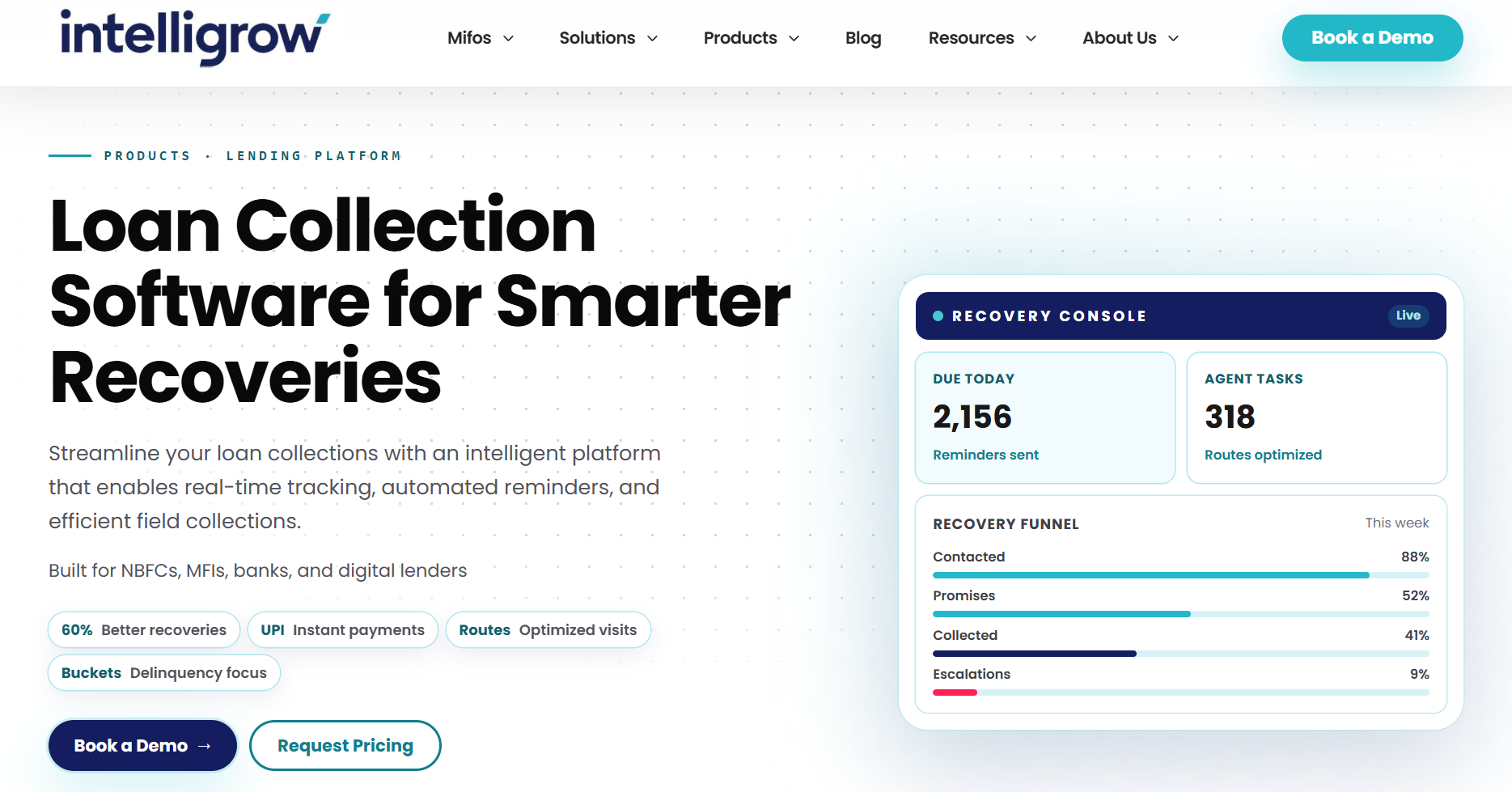
5. Intelligrow Loan Collection Software
Best fit: NBFCs, MFIs, and fintech lenders that want automated tracking and field collections in one console. It suits bucket-based recovery across rural and urban loan portfolios.
Pros
- Mobile-based field recovery lets agents log collection entries on the move
- Predictive collections and early-warning MIS flag delinquency before it worsens
- Automated reminders via email, SMS, and WhatsApp to borrowers and lenders
- Cloud-based and API-driven, integrating with payment and accounting systems
Cons
- Reviewers flag UI and navigation as areas needing improvement
- Less established than larger enterprise vendors
Pricing: SaaS and enterprise models, quote-based.
Check out our blog on debt collection software tools in India
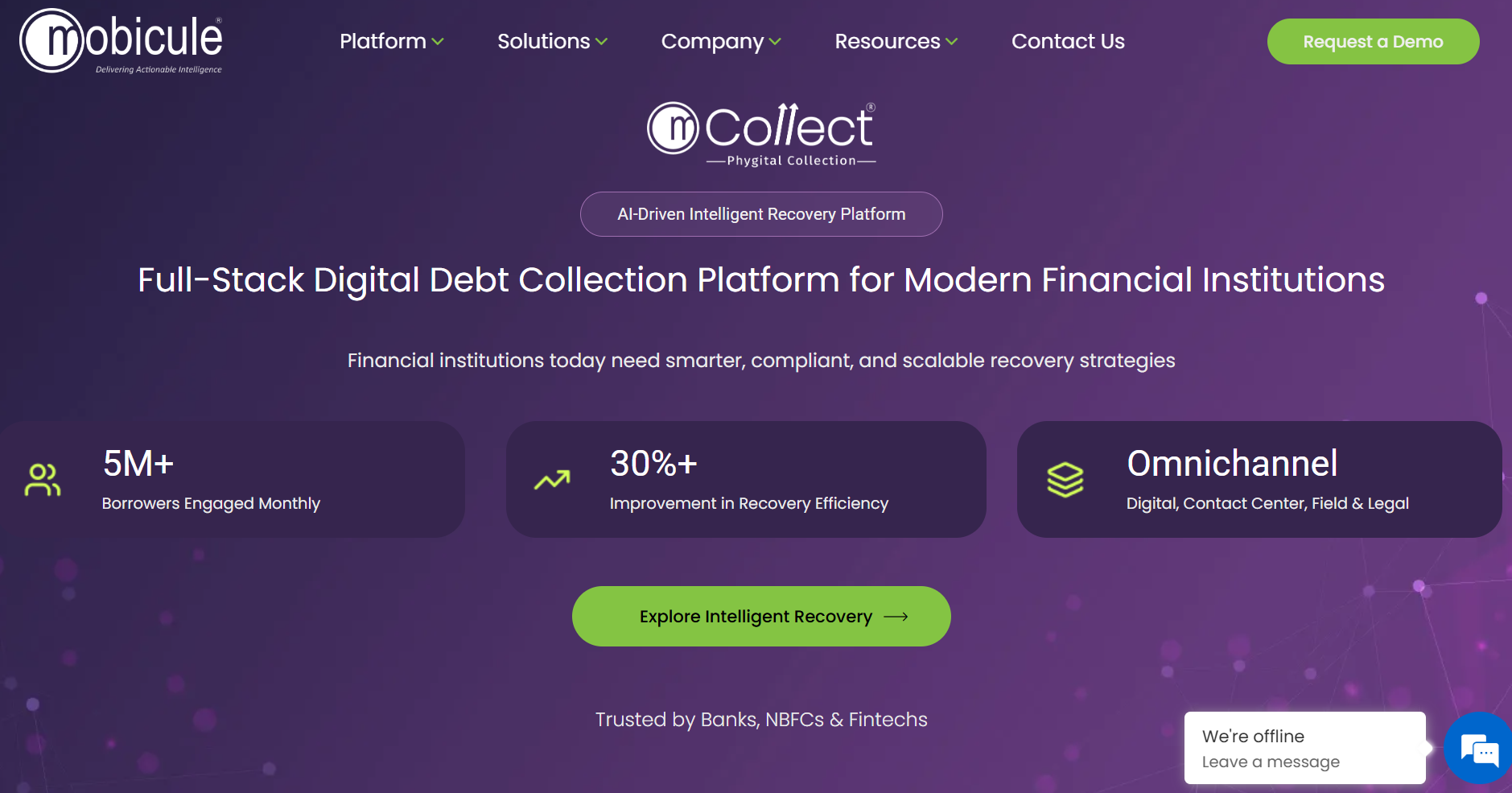
6. mCollect (Mobicule)
Best fit: Banks and NBFCs running high-volume field debt recovery across secured and unsecured portfolios. It fits lenders who need legal, settlement, and repossession workflows integrated.
Pros
- Phygital platform spanning digital collections, contact centre, field, and legal
- Legal and compliance module aligned to TRAI, DPDP Act, and RBI rules
- AI voicebot and intelligent print-to-post for automated borrower outreach
- Built for banks, NBFCs, and fintechs handling large recovery volumes
Cons
- Breadth across channels can mean a heavier setup for smaller teams
- More than a lender needing only basic digital reminders would require
Pricing: Quote-based, not publicly listed.
How to decide which loan recovery software fits?
When choosing a tool, you have to look at where your accounts tend to slip. Some lenders lose accounts early, when reminders go out late or not at all, while others lose them at the end, when a borrower digs in and refuses to pay.
Knowing where your own gaps are makes the choice far easier. These factors help you weigh it.
- Disputed account handling: Ask what happens to the accounts you cannot collect. Check the resolution method each platform supports, and whether the outcome is binding or just another follow-up.
- Recovery stage coverage: Map the tool to your recovery process – check it handles reminders, prioritisation, outreach, field collection, and disputed accounts.
- Multi-channel and field support: For urban, high-volume books, digital channels do most of the work. For rural or cash-heavy portfolios, a strong field app matters more.
- Compliance and audit trails: The platform should log every borrower interaction and meet current loan recovery rules. A clean audit trail lets you stay compliant with RBI guidelines.
- User-friendliness: Pick a loan recovery software tool that is intuitive to navigate. A tool your agents and case officers can’t use well will hold up the entire recovery process.
- Integration support: It should connect with your core lending, payment, and accounting systems. A platform that sits in a silo creates more manual work.
- Scale and pricing fit: Match the tool to your account volume. Most charge on a quote basis, so confirm what you will actually pay for the cases you handle. Also see how debt recovery costs stack up before you commit.
Check out ODR platforms in India for accounts you cannot recover
Recover easily with the right loan recovery software
Loan recovery software reduces manual workload, logs every borrower interaction for audit, and gives teams a clear view of which accounts are moving and which are stuck. When used well, it turns recovery from guesswork into a process you can actually measure and improve.
Look at how quickly your team can onboard it, whether it supports the languages your borrowers speak, and how cleanly it integrates with your existing systems when deciding.
For accounts that stall completely, CADRE (India’s simplest online dispute resolution platform) closes the gap left by the others. It runs arbitration on documents alone, delivers a binding award in as little as 45 days, and reaches borrowers across WhatsApp, SMS, and IVR in their own language.
So, sitting on accounts that won’t settle? Resolve them faster with CADRE
FAQs on loan recovery
These are the methods lenders use to recover non-performing assets, including one-time settlement, SARFAESI action, Debt Recovery Tribunals, the Insolvency and Bankruptcy Code, and arbitration. ODR platforms now add a digital route to resolve these disputes faster.
Most recovery falls into judicial and non-judicial routes. Judicial means going through the courts or tribunals to enforce repayment. Non-judicial covers everything settled outside of them, from negotiated settlements to arbitration, which lenders prefer for speed and lower cost.
Loan recovery is legal when it follows RBI’s loan recovery rules and the Fair Practices Code. Lenders and recovery agents must avoid harassment, respect borrower privacy, and keep communication within permitted hours and channels.
These are the three doubtful asset sub-stages. An account becomes DA1 after staying substandard for 12 months. It then moves to DA2, where it stays for 24 months, and is classified as DA3 from the fifth year of NPA onwards. Provisioning rises at each stage.
It is a platform that supports the full loan lifecycle, from origination and disbursement to repayment tracking and account servicing. This kind of solution gives lenders a single system to manage borrowers, schedules, and payments instead of running them across separate tools.